
Why your CRM is your real product
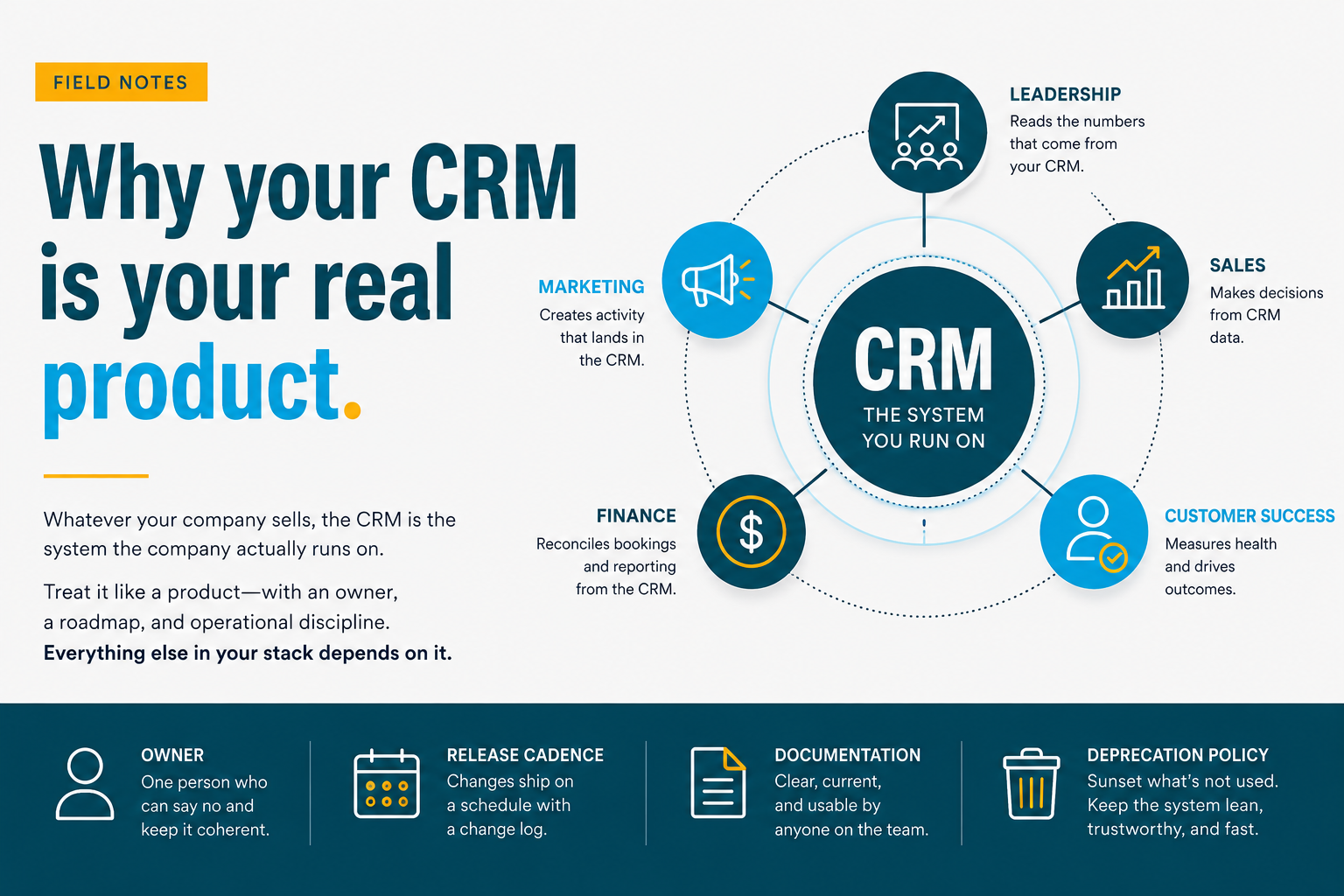
Whatever your company sells, the CRM is the system the company actually runs on. The marketing automation platform produces the activity that lands in it. The sales team makes its decisions out of it. The customer success team measures health from it. The finance team reconciles bookings against it. The board reads numbers that ultimately came out of it.
I have watched a lot of marketing leaders treat the CRM as a back‑office tool that IT or Sales Ops owns and that they have to file tickets against. In practice, the CRM is the longest‑lived asset in the marketing stack, the one most expensive to replace, and the one most likely to determine whether the next campaign produces revenue or noise. Treating it like a product, with a roadmap and an owner and a deprecation policy, is the difference between an operation that compounds and one that resets every two years.
What “treat it like a product” actually means
I do not mean the CRM should have its own marketing site or pricing page. I mean the operational habits we apply to a product we ship to customers should also apply to the CRM we ship to ourselves.
Real products have an owner who can say no. Most CRMs do not. Anyone with admin access can add a field, build a workflow, install a managed package, or change a picklist. Six months later nobody can explain why there are four fields that look like “lead source” with slightly different population rules and one of them is feeding the board deck. A CRM owner who can say no - who maintains a written intake process for new fields, requires a stated business reason, and sunsets the field if the reason goes away - is doing the same job a product manager does on a real product. The system stays coherent because somebody is paid to keep it coherent.
Real products have a release cadence. Most CRMs do not. Changes ship continuously, often in the middle of a campaign, often by a vendor or partner who is not on the marketing team. The result is that a workflow that worked on Monday breaks on Wednesday and nobody can reconstruct what changed. A CRM run as a product has a release window, a change log that humans actually read, and a freeze period before high‑stakes events. None of this is hard to set up. It is unglamorous, and it is almost always missing.
Real products have documentation. Most CRMs do not, beyond whatever the original implementer wrote and whatever the most recent integration vendor stuck into a help article. Documentation here does not mean a help center. It means a written description of every custom object, every non‑trivial workflow, every integration, every report that anyone outside the marketing team relies on. The test is whether a person joining the team in nine months could read it and operate.
Real products have a deprecation policy. Most CRMs do not. Fields and workflows accumulate. The instance grows. The field count crosses a thousand. Nobody removes anything, because removing a field involves explaining to seven people why their report broke. The right move is a quarterly review where dormant fields are flagged, owners are asked to defend them, and the unowned ones are archived. The point is not aesthetic. The point is that an instance with three thousand fields is operationally untrustworthy in a way that an instance with three hundred is not.
Why this is now urgent rather than important
The reason to write this down in 2026 rather than in 2018 is that the volume of automated changes hitting the CRM is now an order of magnitude higher than it used to be. Workflows generated by an LLM are landing in the instance. Integrations with AI‑native point tools are writing into the instance. Sales reps are using assistants that update fields without the rep noticing. Every one of those is a production change to a system the company runs on, and most of them are happening without an owner, without a release cadence, without documentation, and without a deprecation policy.
The CRMs we are inheriting now are noticeably worse than the ones we were inheriting two years ago, on every dimension we measure. Not because the platforms got worse - they did not - but because the rate of unowned change has gone up. (An earlier post on what that vibe‑coded automation pattern looks like.)
The teams that will be in good shape in three years are the ones that started treating the CRM as a product now, while the volume is still recoverable. The teams that wait until the field count is past three thousand will be having a different and more expensive conversation.
What this looks like for a marketing leader
If you are running marketing and the CRM is owned by somebody else - Sales Ops, RevOps, IT - the move is not to take it away from them. The move is to make sure the product habits above are happening, regardless of which org chart box owns the admin seat. If they are not happening, the marketing operation you are running is being built on sand, and no amount of campaign work is going to fix that.
If you are running marketing and the CRM is owned inside your team, the move is to be honest about whether you are operating it as a product or as a back‑office tool. The honest read for most teams is the second one. The path to the first one is a written owner, a written intake process, a written change log, and a written deprecation policy. Four documents, none of them long, all of them missing in most instances we audit.
Where this leaves the work
The CRM is not glamorous and it does not show up in the agency pitch deck. It is also the part of the stack that determines whether the rest of the stack is doing useful work. We spend a non‑trivial fraction of our hours on CRM hygiene for exactly this reason - it is the highest‑leverage place to apply discipline, because everything else reads from it.
If your CRM has crossed into the territory where nobody can fully explain what is in it, that is the kind of cleanup we do for a living. We are reachable, and the first conversation usually starts with a field count and a list of who owns what.
Put the method on paper: the Tactical Marketing Workbook.
The full methodology converted into working sessions - eight phases of fill-in worksheets, exit checklists, and one-week action steps. Print it, work one vertical at a time, and turn the framework into decisions your team has actually made.
Philip Easley-Bosley is the founder of Tactical Marketing and a thirty-year expert marketing consultant. His path to founding the firm ran through sales and marketing leadership, years inside Act-On Software consulting with thousands of clients as Lead Marketing Automation Strategist, and a consistent priority on training and team building that a linear career could not have produced. He sets strategy, owns the architectural calls on every engagement, and writes about marketing operations, automation, and the discipline of building systems that hold up on Monday morning.