
HubSpot: trust isn't an optional feature
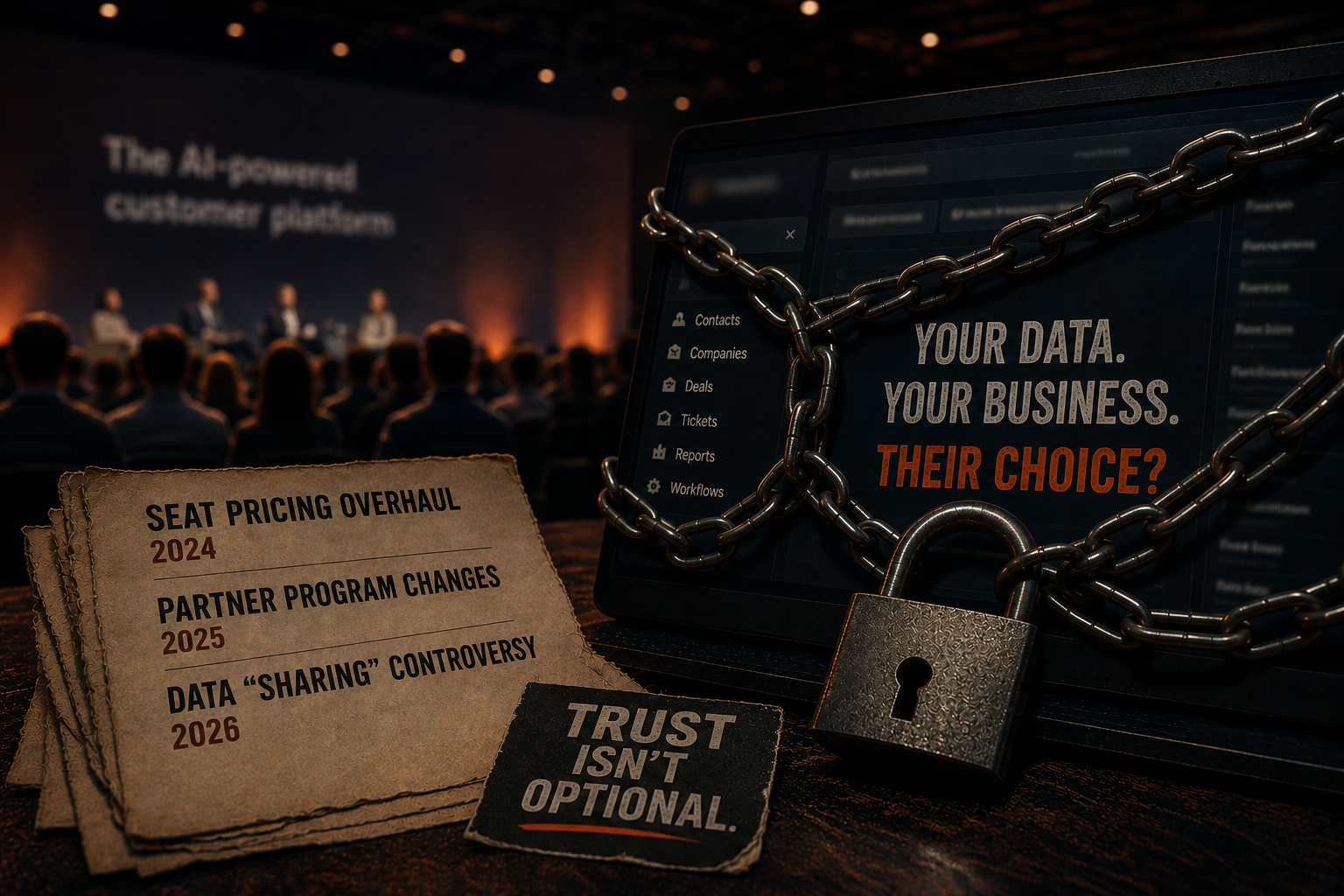
Trust, as HubSpot itself used to teach, relies on permission and permission is asked for, earned, and given; it is never defaulted.
Throughout my career, I've been a Partner, an advocate, and a fan. I'm a HubSpot shareholder out of principle. I use the platform daily, and this team holds HubSpot certifications across Marketing Hub, Sales Hub, and email. We have built client operations on this platform for years. That operational history is why what happened in July 2026 matters, and why I'm giving you the dates and the paper trail rather than a reaction.
The controversy
On July 1, 2026, HubSpot published terms tied to Contact Discovery, a prospecting product planned for August 4. The change would have allowed enrichment data from your account - business contact details, employer information, deliverability signals - to be shared across accounts, feeding a dataset used to supplement other customers' records. Potentially including your competitors'. Everyone was in by default unless an admin opted out, as reported by CMSWire, "before August 4."
After four days of backlash, HubSpot reversed course. Co-founder and CTO Dharmesh Shah conceded: "You are right. We made a mistake and have taken steps to correct it." Chief product and technology officer Duncan Lennox posted a full reversal titled "We Got This Wrong. And We Are Fixing It," committing that future enrichment features would be "fully and transparently opt-in."
We made a mistake. Nothing matters more to us than the trust of our customers, and with our recent terms of service update we let you down. We are sorry about that. We will not move forward with the terms of service changes we communicated on July 1, 2026.
— Duncan Lennox, Chief Product and Technology Officer, HubSpotCredit where due: the reversal came fast and the apology was unhedged. What kept bothering me afterward was the default itself, because customers were never arguing about whether better enrichment would be useful. They were arguing about permission. HubSpot did not ask whether customer data could become part of a shared commercial dataset. It announced that admins could opt out, which is a different transaction entirely: by the time you hear about an opt-out, the decision has already been made without you.
And the default was not a one-off oversight. The paper trail on this specific data program runs back further than the apology.
- September 18, 2024The quiet terms change
The authorization to copy your enrichment data into HubSpot's commercial dataset entered the Product Specific Terms. There was no email and no banner. Clark Barron, founder of the GTM threat-intelligence firm Blackout, pulled the paper trail after the apology and titled his advisory "The 652-Day Gap."
- 2025The removed sentence
For part of the year, a HubSpot knowledge base article said: "HubSpot won't share the data listed above with other accounts." The sentence was later removed. Barron, via MarTech: "They didn't just fail to tell you. They told you the opposite, then removed the sentence."
- July 1, 2026The opt-out default
The one you just read about. Every portal was in unless an admin acted on a single email by August 4.
between the data-sharing authorization entering HubSpot's terms and the email telling customers about it.
This one landed differently because HubSpot never sold just software - it sold a philosophy: earn attention, create value, ask permission, and build trust. Then the company that taught the industry to ask first defaulted customers into donating the database.
A message to HubSpot
HubSpot, if you're reading this, know that as a customer, a partner, and a shareholder - I think this was dirty and I don't like it. I want you to be a company I can be proud to associate with, and this isn't it.
The real lesson
I'm an emotional guy, and it took a couple of days to stop being mad. I almost missed the most important take away here.
Your data is so valuable HubSpot built a product out of it. But are you getting value out of it?
That is the part most companies should sit with, because I get into HubSpot portals all the time and find the same pattern. Sales touches the data, uses whatever helps in the moment, and discards the rest. Marketing collects plenty but does not trust what it collects, so campaigns run on instinct. The reporting leadership keeps asking for never quite arrives, because the lifecycle stages underneath it are a mess, and the admin who inherited the portal is stuck maintaining fields nobody can explain. Meanwhile contacts pile up, companies duplicate, forms ask questions that never shape a single follow-up, and reps leave notes that never trigger anything.
All of that data sits in the portal producing nothing, which in practice is a bigger waste than anything HubSpot tried to do with it. HubSpot saw enough commercial value in customer records to build a product on top of them. The customers who actually own those records mostly treat them as an admin chore, something to clean up when a report breaks. Closing the gap between those two postures is the real work.
We built a methodology - and a business - around this exact problem: helping companies turn CRM and marketing automation data into action. Actual operational pull - the kind that changes who gets contacted, when they get contacted, what they receive, and what happens next.
What you should be doing
Your database only produces revenue when three motions run as a loop. Each one feeds the next.
Clean the data and cut it into audiences that mirror how you actually sell, because every decision downstream inherits the quality of this cut.
Read the behavior your buyers are already showing you and let it decide who hears from you next, and what they hear.
Put programs on watch so the follow-up, the alerts, and the handoffs fire on time whether or not anyone is at their desk.
Segmenting
Know the data, keep it clean, and make it work for you. Segmentation is not just list building - it is the foundation of personalized marketing automation, and if your database is one big pile of contacts, your automation can only behave like a slightly more expensive newsletter tool.
Start with the basics:
- Clean, deduplicated records
- Coherent, documented fields
- Standard lifecycle stages
- Clear company associations
- Defined buying roles
- Reliable source data
of companies' data meets basic quality standards, per a Harvard Business Review study of 75 executives who audited their own records. Odds are, your database needs work before it can produce.
You should be able to cut your database by lifecycle stage, fit, and behavior in a few clicks - and know who is a customer, who is an open opportunity, who is a qualified prospect, who is engaged but not ready, and who has gone cold. If you can't, start there before spending anything on personalization, because personalizing off a database you cannot segment is decoration, not strategy.
Targeting
Put the data to work deciding who hears from you next. This is where most companies underuse HubSpot: they capture activity but never convert it into action. A prospect visits the pricing page three times and nobody notices. Another clicks every email about one specific service, which is about as clear as a buying signal gets, and the pattern dies in an activity feed. A contact at a target account starts browsing late-stage content the same week a lead with six months of engagement quietly goes cold, and neither event changes what anyone does on Monday.
is the average time companies take to respond to a new lead - and 23% never respond at all, per Harvard Business Review's audit of 2,241 companies. The activity gets captured. The action never fires.
more likely to qualify a lead: firms that contacted prospects within an hour, versus those that waited even a single hour longer, per the same HBR research. Speed to follow-up is the single biggest lever most teams are not pulling.
Score your contacts, build hot lists, run call campaigns from behavior rather than vibes, follow up with everyone who raised a hand, re-engage the ones going cold before they're gone, suppress the people who shouldn't hear from you, and route the right leads to sales before the moment passes. You already hold the data for every one of those moves. What most teams are missing is the decision layer that turns it into the next call, the next send, the next handoff.
Automating
Good programs exceed human ability, and that is the honest case for them. A rep cannot follow up with a thousand contacts at exactly the right moment, and asking a marketer to manually adjust every journey around every meaningful behavior is a staffing plan, not a strategy. There are lifecycle changes, form fills, stale deals, and missed follow-ups happening in your portal right now that no manager will ever see. A well-built program watches all of it, every day, and never drops one.
average increase in sales opportunities for companies that run lead nurturing programs, per Forrester Research. That output only happens when the program runs consistently - every day, for every contact, without someone manually triggering it.
So automate everything you can't manage individually: the follow-up, the reminders, the lifecycle changes, the re-engagement, the sales alerts, the internal handoffs, the suppression logic. Built correctly, marketing automation is not "send more email" and it is not "replace the humans." It makes sure the right human action happens at the right time, because the system is watching what no person can watch manually. That is how your database becomes an operating system.
Make your data work for you first
HubSpot said the right words, and said them fast. But words are not the record - the 652-day paper trail is.
I am still annoyed about the default, and I plan to keep telling HubSpot to do better. In the meantime, read the terms, check your data and AI settings, and keep your data clean enough to export if you ever need to leave.
But don't stop at defense. The bigger lesson is offensive: your CRM data is valuable, and HubSpot just proved it. Run the loop above on it, govern it like the asset it turned out to be, and make it produce for your business before anyone else finds a way to make it produce for theirs.
I still believe the thing HubSpot taught me years ago, that trust runs on permission you ask for and earn. This week I watched the company that wrote the lesson forget it.
We spend our days inside HubSpot portals turning databases like yours into revenue assets: cleaned, structured, segmented, and automated. If yours is still a storage problem, see how we work with HubSpot.
Put the method on paper: the Tactical Marketing Workbook.
The full methodology converted into working sessions - eight phases of fill-in worksheets, exit checklists, and one-week action steps. Print it, work one vertical at a time, and turn the framework into decisions your team has actually made.
Philip Easley-Bosley is the founder of Tactical Marketing and a thirty-year expert marketing consultant. His path to founding the firm ran through sales and marketing leadership, years inside Act-On Software consulting with thousands of clients as Lead Marketing Automation Strategist, and a consistent priority on training and team building that a linear career could not have produced. He sets strategy, owns the architectural calls on every engagement, and writes about marketing operations, automation, and the discipline of building systems that hold up on Monday morning.
This piece was produced with AI assistance, and we'd rather tell you than have you wonder. Phil set the argument, made the judgment calls, and owns every word under his byline; AI helped compile the dated timeline, cross-check the sourcing, and tighten the prose. It's the same human-plus-AI workflow we build for clients - disclosed here for the same reason this article exists: you should know what's happening inside the tools you trust.