
Why our Act-On audit is free
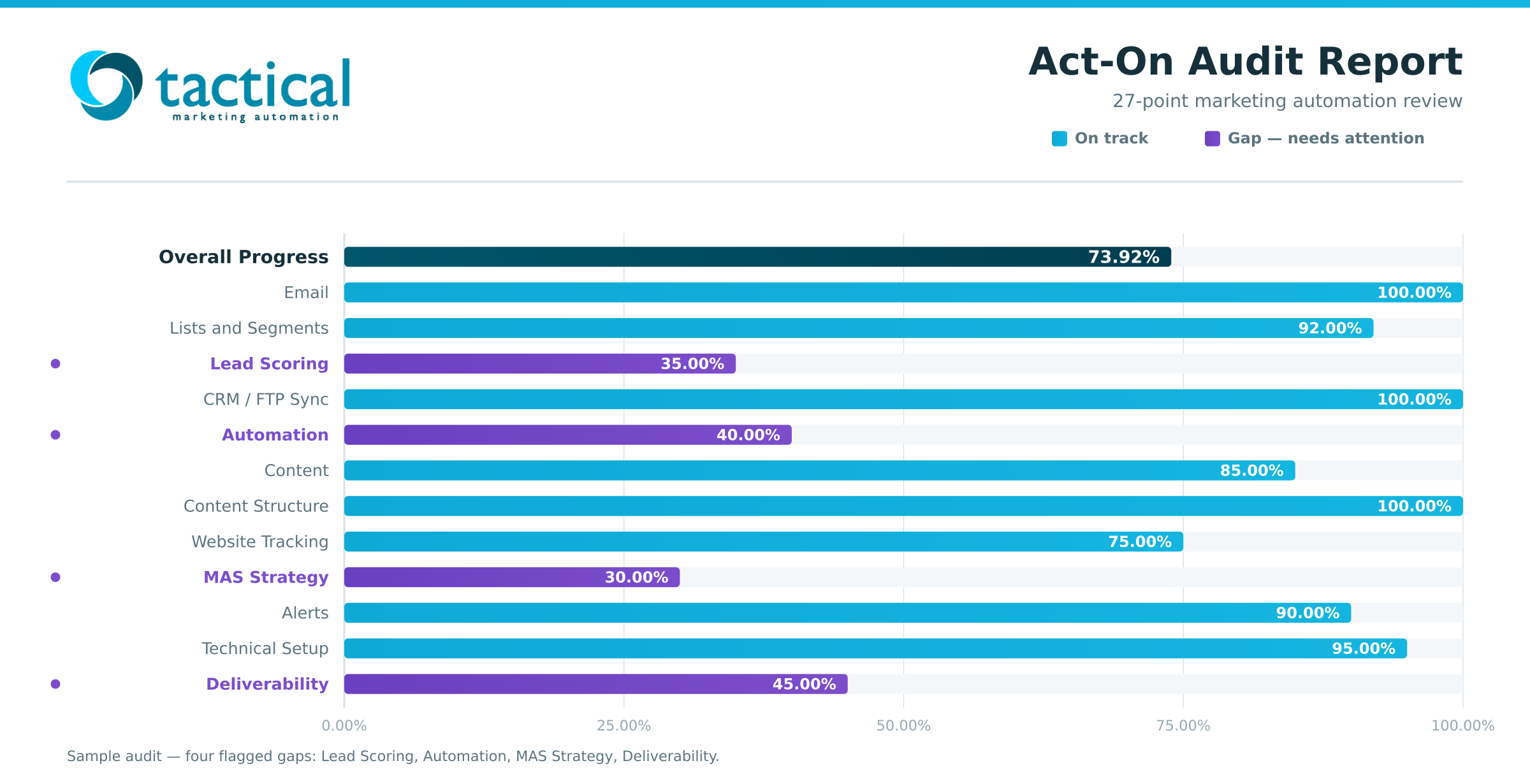
Most Act-On instances I open are running at maybe a third of what the platform can actually do. Not because the team is lazy or the platform is weak. It is because nobody ever sat down, read the whole instance at once, scored it honestly, and told them which of the forty things they could fix this quarter are the three that actually matter.
That reading is what our Act-On audit is. We do it for free, and the rest of this post is what it covers and why we do not charge for it.
What the audit actually is
The audit is a structured, 27-point review of your Act-On account across every category that determines whether the platform is earning its keep. We look at Email, Lists and Segments, Lead Scoring, your CRM and FTP sync, Automation, Content and the way that content is structured, Website Tracking, Alerts, the technical setup underneath all of it - DKIM, SPF, SSL, the vanity URL - and Deliverability.
That list looks like a checklist, and a checklist is the easy half of the work. The half that matters is that we read each area two ways.
The first read is feature usage. Is lead scoring turned on, and is it scoring on behavior that means anything. Are your lists static dumps or are they segmenting off live criteria. Is the beacon actually placed and firing. Is DKIM signed and aligned, or is it the default that quietly caps your inbox placement. Most audits stop here, and stopping here is how you end up with a report that says you are using 60 percent of the features and a pipeline that is still flat.
The second read is strategic. Does the lead scoring model agree with the segmentation. Does the segmentation agree with what the CRM thinks a qualified lead is. Do your automated programs hand off to a sales motion that exists, or do they route leads into a stage nobody owns. A platform can score well on every individual feature and still be broken, because the features are not talking to each other. Act-On is a connected system, and a connected system has to be audited as one.
Then we score it. Every category gets a number, the numbers roll up, and the whole thing turns into a prioritized set of recommendations - not a list of everything that is wrong, but an ordered list of what to fix first, ranked by the impact it will have against the effort it takes. You should be able to read the first three items and know exactly what your team is doing on Monday.
Why this is hard to do from the inside
Marketing automation is not a native language for most marketers, and that is not a knock on marketers. The discipline asks you to think like a programmer - branching logic, data models, conditional triggers, field-level hygiene - and bolt that onto a creative skill set built around audience, message, and timing. Those two ways of thinking do not naturally coexist in the same person. What usually happens inside a team is a quiet collision between the marketing instinct and the IT or engineering instinct, and the instance ends up reflecting whichever side happened to build it.
That is the gap the audit closes. Our background is marketing operations - the seam where those two ways of thinking are supposed to meet - and we have spent close to fifteen years inside Act-On specifically, across thousands of use cases. When you have seen that many instances, you stop guessing at what good looks like. You know it on sight, and more usefully, you know which fix produces an immediate result and which one is a six-month project dressed up as a quick win. That is the difference between a list of problems and a plan.
Why we do not charge for it
The honest answer has three parts.
The first is that the pool of people who actually know Act-On at depth is small. There are far more HubSpot and Marketo specialists than there are Act-On natives, which means a lot of Act-On customers are running the platform without ever having had a real expert read their instance. We would rather be the firm that reads it.
The second is the platform itself. Act-On gives marketers the liberty to build the program they actually want instead of forcing them onto a vendor's rails and a vendor's worldview. We like that, because it rewards teams who know what they are doing - and it means an audit is genuinely worth running, since the instance in front of us is a real set of decisions rather than a template everyone shares.
The third is the part that matters most to you. A free audit takes the risk off the front of the relationship. You do not have to trust us on the strength of a pitch deck. We do the work first, in your real instance, and you see exactly how we think before any money changes hands. If the audit is good, it earns the next conversation, and we are betting that often enough it does. That is the whole strategy: demonstrate the value up front, earn the trust, and hope it turns into a recommendation and, eventually, your business.
One thing we are always transparent about: a real audit reads your real instance, so it does require access to your Act-On account. We are not scoring a questionnaire. We are in the platform, looking at the same screens your team looks at, which is the only way the recommendations are worth anything.
If your Act-On instance has never had an expert read it - or it has been a couple of years and a few team changes since the last one - this is the low-risk way to find out where you actually stand. Request your free Act-On audit here. We will read the instance, score it, and hand you the prioritized list. What you do with it is up to you.
Philip Easley-Bosley is the founder of Tactical Marketing and a thirty-year expert marketing consultant. His path to founding the firm ran through sales and marketing leadership, years inside Act-On Software consulting with thousands of clients as Lead Marketing Automation Strategist, and a consistent priority on training and team building that a linear career could not have produced. He sets strategy, owns the architectural calls on every engagement, and writes about marketing operations, automation, and the discipline of building systems that hold up on Monday morning.