
OpenAI sold me on ChatGPT Ads with an email
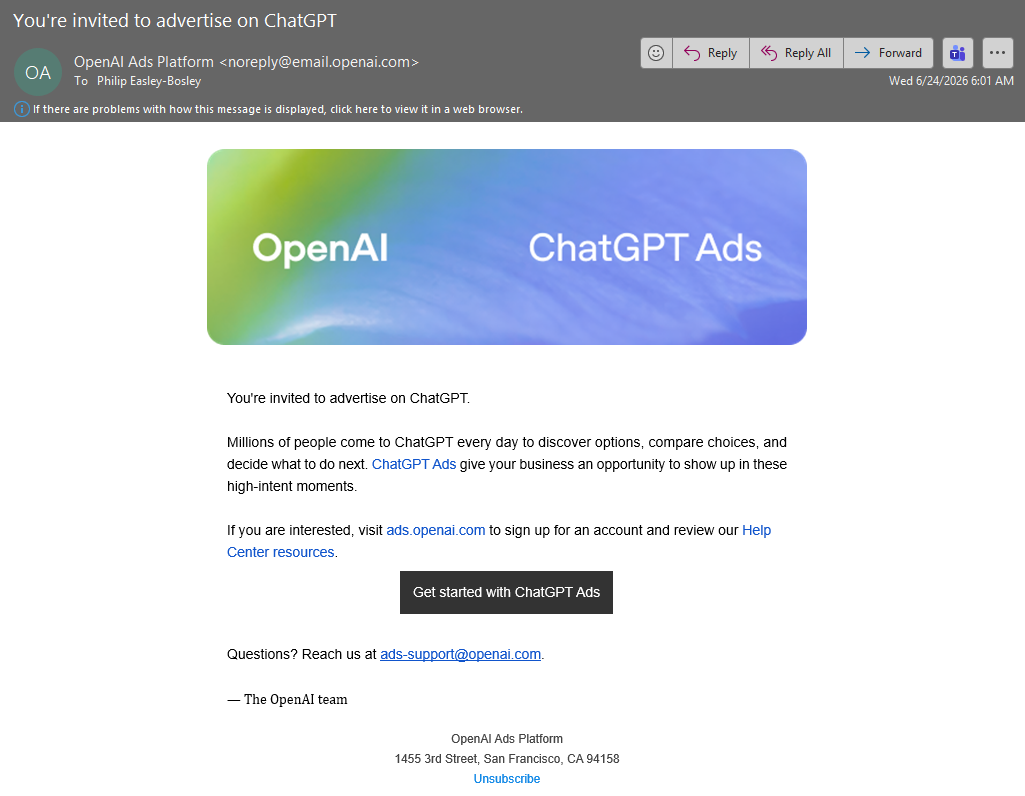
Your most expensive ad channel just sent you an email, and the choice they made tells you something that every B2B automation benchmark has been saying for ten years.
In June 2026, OpenAI launched ChatGPT Ads - a sponsored placement inside ChatGPT conversations. That launch got real coverage, and if you are a B2B marketer thinking about where your buyers spend time, it matters. So how did OpenAI choose to tell me I could advertise on the most talked-about AI platform in the world?
They sent me an email. Subject line: "You're invited to advertise on ChatGPT." A header graphic, three short paragraphs, a CTA button. No in-app notification inside their own product. No LinkedIn campaign. An email to a marketing automation consultant.
The company with more unprompted press coverage than most brands will ever see chose the inbox to reach buyers. That was not an accident. It was a read on where a specific, relevant message actually lands - and it is the same read that drives every lifecycle program worth building.
Why email still wins on conversion
The data is not subtle. Email converts at 4.34% across B2B programs. Paid search comes in around 2.06%. Organic SEO at 0.95%. Social at 0.38%.
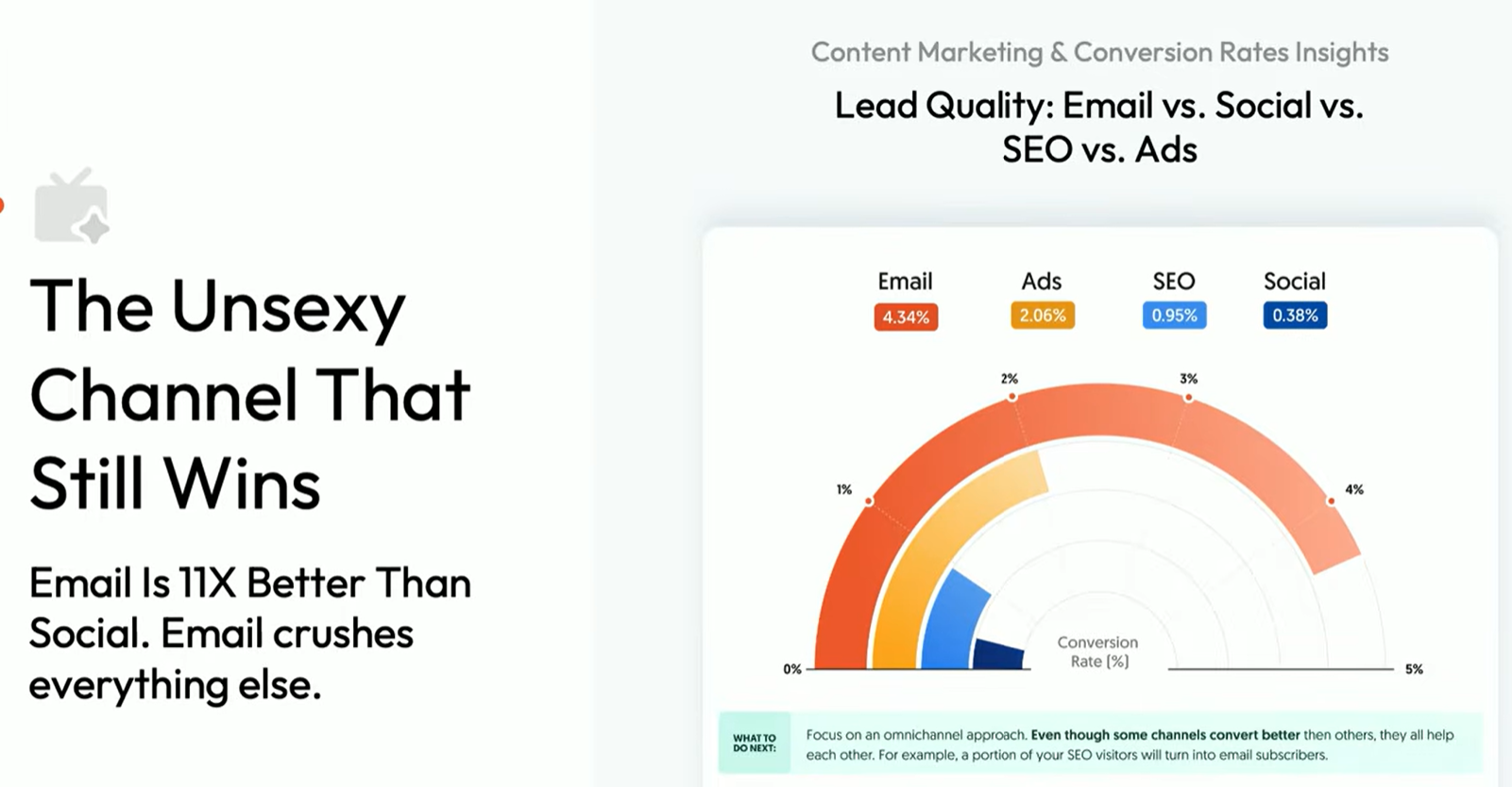
Email converts at more than twice the rate of the next best channel and more than eleven times the rate of social. Neil Patel has described email as "the unsexy channel that still wins." He was making a point about this conversion gap, and the data backs him up. But the more important observation is why it wins - and the answer sits in how the program is designed, not in the channel itself.
The inbox is an environment where the buyer has already opted in. They are not competing against ten other brands in the same viewport. A targeted message at the right moment lands without the noise every other channel carries. The complete marketing process has not changed in its essentials because buyer psychology has not changed: the right message, to the right person, at the right time. Email is the channel most consistently in a position to deliver all three.
AEO is SEO - the same fundamentals, a different surface
There is a lot of noise right now about AEO (Answer Engine Optimization) as though it has replaced what we know about organic search. It has not. AEO is SEO applied to a surface where results appear as sentences instead of links. The same discipline that earns page one earns the AI citation.
The signals that determine whether your content gets cited in a ChatGPT or Perplexity response are the same signals that have always determined whether a page ranks: authority, specificity, accurate claims, clear structure, and genuine relevance to the question. This is why the strategic copywriting guide we use internally has not needed a fundamental rewrite for the AI era - the principles were already correct. An AI generating a summary is doing pattern recognition on the same quality signals search has measured for years.
The teams whose content is being cited in AI summaries are, almost without exception, the teams that were already writing for actual humans first. That is not a coincidence - it is the result of the same discipline that drives every content audit we run before recommending a new channel.
Where the program has to evolve
None of this is an argument for ignoring new channels. ChatGPT Ads are a real placement and they belong in a serious B2B media plan. AI-generated answer pages are increasingly the first surface a buyer encounters before they ever reach your site. A search ranking from three years ago may not carry the same protection it did in 2022.
The program that serious B2B brands need to run is a full operation where each channel does what it is best at. Paid placements and AI Ads reach buyers at the moment of active intent. AEO-structured content earns the citation in the AI summary. Email closes the loop on buyers who have engaged but have not yet made contact.
The marketing operations work we do is largely about connecting those channels so the signal from one informs the behavior of the others. A buyer who clicked a ChatGPT Ad, read a resource page, and then opened your email is a different buyer than one who only received the email. Knowing that changes the message, the timing, and when you hand them to sales.
The channel that was always doing the work
The teams that compound over the next three years are the ones who treat email as the converter at the center of a multi-channel program, not a channel to eventually replace. The channels around email will keep changing. The inbox has not - and neither has the case for building a real email program.
OpenAI proved this when they launched a product category worth hundreds of billions of dollars and chose email to announce it. The most talked-about AI company in the world, with a chat interface on every screen, sent a plain email to reach buyers.
If your program is producing content, running campaigns, and not converting at the rate your pipeline requires, the problem is almost never the channel you are missing. It is the targeting, the message, or the moment. Those are solvable. We have solved them inside every major automation platform, at budgets from startup to enterprise. The email and lifecycle work is still where most of that starts, and where most of the results live.
Put the method on paper: the Tactical Marketing Workbook.
The full methodology converted into working sessions - eight phases of fill-in worksheets, exit checklists, and one-week action steps. Print it, work one vertical at a time, and turn the framework into decisions your team has actually made.
Philip Easley-Bosley is the founder of Tactical Marketing and a thirty-year expert marketing consultant. His path to founding the firm ran through sales and marketing leadership, years inside Act-On Software consulting with thousands of clients as Lead Marketing Automation Strategist, and a consistent priority on training and team building that a linear career could not have produced. He sets strategy, owns the architectural calls on every engagement, and writes about marketing operations, automation, and the discipline of building systems that hold up on Monday morning.